



{{ p.category }}
{{ p.title }}
{{ p.excerpt }}
{{ p.meta }}ROV footage sits in one place. Inspection reports sit in another. The context that explains both lives in someone's head.
Every campaign starts by rebuilding a picture that should already exist, and every hour spent doing that is an hour not spent on the asset.
Operators already have data. What they lack is understanding.
Enaimco puts verified, contextualised data in front of the people making the call, so your engineers plan faster, decide with confidence, and spend their expertise on the asset instead of the admin.
Campaign context is ready before you start, not rebuilt each time.
One verified operational view, shared by every team. No working from assumption.
Automation handles the repetitive work so your team does what matters.
Assets, data, workflows and teams live in a single, continuously updating system. One verified source of truth. No silos to bridge and no tools to stitch together.
The right call, made once.
Planning, execution and close-out, connected.
Every record tied to a tag, a place and a history.
Migrated, remediated and verified at source.
Every record findable in seconds, wherever it came from.
Condition-based decisions that extend the life of the asset.
Tighter campaign scope. Fewer days offshore.
Automation removes the manual work that fills engineering weeks.
Nothing about the field changed. What changed was how the campaign was planned and evidenced.
See what a tighter campaign scope is worth across a year.
No parent company selling manhours, vessels or equipment.
One platform, not integrated tools.
Not a service company with a coded side product.
We absorb the complexity so your team spends its time on decisions.
Your controlled document record stays where it is. Work orders keep running in the maintenance system you use today. Process data flows into the operational twin with its context attached. ETL and integrations are handled by Enaimco.
The controlled record stays put
Your document repository stays the system of record, tied to the asset it describes.Many systems, one operational view
Connected in one place they become a single source of truth, and operators routinely retire the tools they were holding together by hand.Deployment runs through the same five stages every time, shaped around your operation. Usable outcomes arrive in weeks rather than at the end.
Every piece of data, every workflow and every decision is anchored to the physical asset it belongs to. Not the project that produced it. Not the team that recorded it. Not the system it was stored in. The asset.
The offshore industry is structurally project-centric. FEED is a project. Installation is a project. Each inspection campaign is a project, and the data lives wherever that project lived. By the time an asset reaches operations, its history is scattered across a dozen owners. Enaimco is built the other way round, so information accumulates over the life of the asset instead of being lost at every handover.
Enaimco is built as four layers. Decisions rest on workflows, workflows rest on context, and context rests on the data underneath. Most platforms sell the top layer and leave you to build the bottom one. We start at the bottom.
The right call, made once, on a complete and current picture.
Planning, execution and close-out connected, so work in one place updates everything downstream.
Every record tied to a tag, a place and a history, automatically.
Your existing data migrated, remediated and verified at source.
See the data foundationA defect logged in anomaly management flows into IMR planning, drives campaign execution, and updates the next inspection interval. Each module hands context to the next, so the platform gets more useful the more it is used.
Historical data
Live process data
Contextualisation
 Field overview
Field · North · 1,284 assets · Campaign 26-02
Field overview
Field · North · 1,284 assets · Campaign 26-02
Enaimco sits on top of the systems you already run. It reads from them, writes back where that helps, and does not ask you to replace anything.
Your controlled document record stays where it is. Maintenance and work orders stay in your existing process. Live process data is read into the operational twin in context. Where a connection does not exist yet, we build it.
One platform inside. Open by design outside.
Enaimco is designed to be the place the job is done. Inspections are planned and executed in the platform. Anomalies are logged there. Media is captured and linked as it arrives. Context becomes a by-product of doing the job, with no re-entry and no assembly after the fact.
The platform also connects outward, pulling from ERP systems, sensor feeds, SCADA and historians. The priority stays the same though. Bring the workflow inside Enaimco, because that is what keeps the data trustworthy.
Nobody outside the integrity team has a real mental model of what is down there, how it connects, or what condition it is in. That gap costs more than it looks. It slows every conversation with management, every handover to a contractor, and every question from a regulator.
If you can see it, you can understand it.
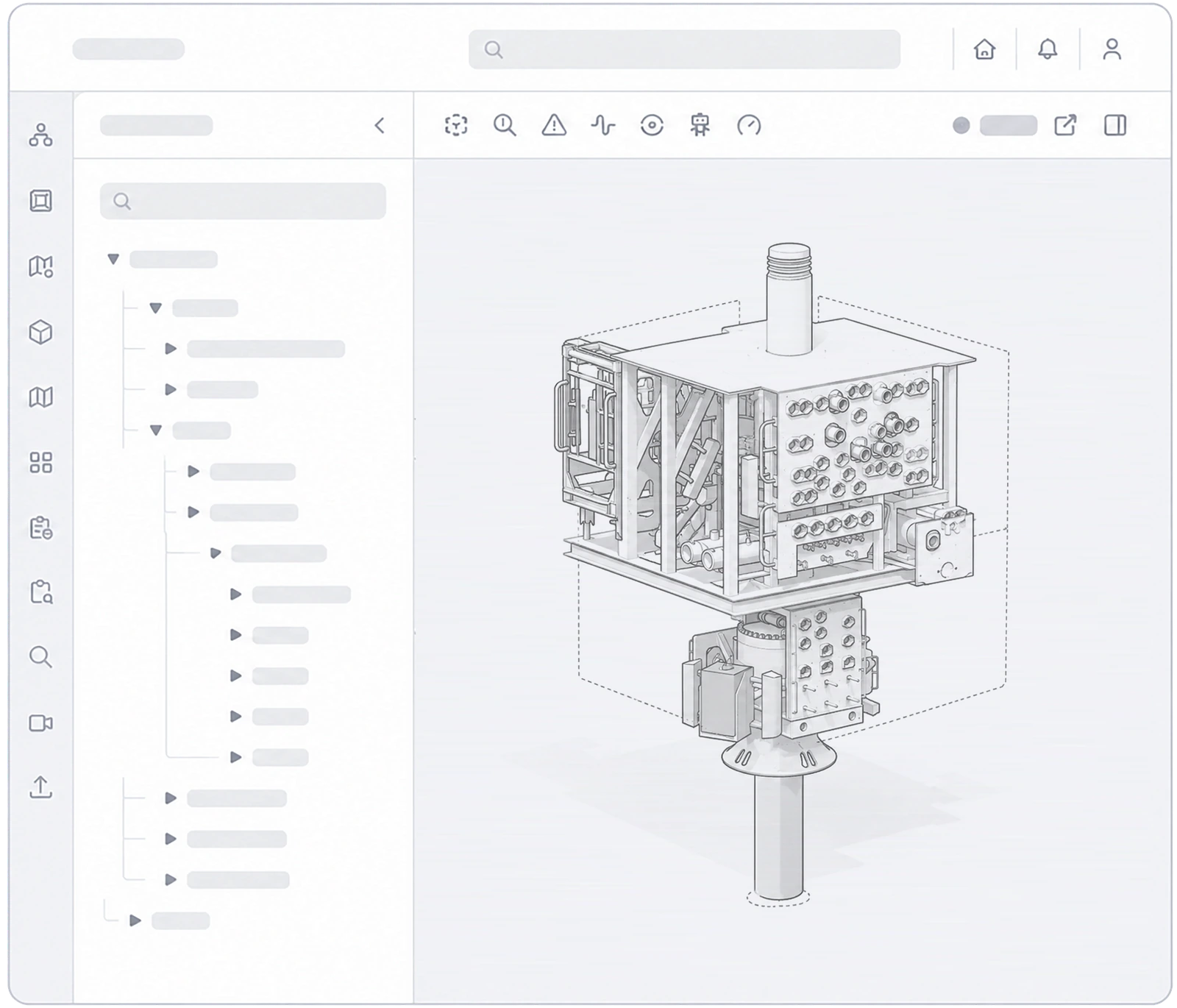
Enaimco's 2D and 3D environments are embedded directly in operational workflows. This is where engineers interact with their assets, enter data, review anomalies and plan work. Navigate to a specific valve or structure and the media, documents and history tied to it are already there.
Working inside the model also improves the data. Spatial context makes errors obvious in a way a register never can. An inconsistency that hides in a spreadsheet row is visible immediately when it is drawn in the right place.
Most tools in this market represent the asset at system level. You learn there is an issue on the tree, then interpret drawings and text to work out which component is affected, and the real understanding stays in one engineer's head.
Enaimco ties anomalies, findings and actions to the exact component. The valve, the clamp, the connector, the structure. Anyone can look at it and understand the issue, whether or not they were the one who wrote it up.
When contractors work inside a visual environment tied to the real asset, what they enter is more accurate, because they can see immediately when something is wrong or out of place. Operators who know their contractors are working in Enaimco have considerably more confidence in the data coming back.
That confidence matters downstream. Risk scores, IMR scope and anomaly decisions are only ever as good as the data underneath them.
Management get a view of the asset without needing a subsea background. Regulators can be given a window into operations rather than a report about them. Contractors and operators discuss the same component, on the same model, with no ambiguity about what is being described.
Operators hold decades of information in incompatible formats. Inspection reports, as-built drawings, historical media, spreadsheets, handover packs from contractors who left years ago. There is no capacity to re-enter it by hand.
If going live means three years of manual data entry, it never happens, and the team stays on spreadsheets. Several major operators have said plainly that they will not switch a platform on until the source data can be trusted.
Enaimco manages the full process. Ingestion, cleansing, normalisation and contextualisation, all handled by our team. The 2D and 3D environment is built by subsea specialists from your as-built drawings and any existing models.
This is the difference between a licence and a partnership. Most vendors hand over an empty system and a training session. We hand over a populated one.
Send us what you have. We will tell you what is missing.
Every asset carries a quality score from the start, so gaps are visible on day one rather than discovered mid-campaign. Engineers can work through them systematically instead of finding out the hard way that a record was never complete.
A populated environment you can trust from the day you log in.
Data born in Enaimco never has to be moved, re-entered or reconstructed.
Scope built on a complete baseline rather than a partial one.
Post-campaign reports built on complete records.
Trident acquired a mature field and inherited incomplete documentation from the previous operator, which is one of the hardest starting positions in the industry.
No parent company selling you manhours, vessels or equipment. Our only interest is how well the software performs for you. When the platform recommends a smaller campaign scope, there is nobody upstairs who loses revenue on that recommendation.
Full data access and networked workflow automation in one platform, not a set of integrated tools. Every capability shares the same data model, the same architecture and the same interface, so there is no integration overhead when you add another.
Not a service company with a coded side product. Software is what we do, and the people building it have worked offshore. Every module started with a real operational pain point and was refined with the onshore and offshore teams who use it.
Enaimco absorbs the complexity so your team spends its time on decisions. We migrate and remediate your data, build the model from your as-builts, and manage the integrations.
Time spent with the teams doing the work, defining the real workflows.
Engineering judgement on what should be automated and what should not.
Designed against the operational decision, with user feedback shaping it.
Released, used on a live campaign, then sharpened.
Same assets. Same regulator. One connected platform instead of spreadsheets, emails and Word docs.
These are modelled outcomes rather than measured averages. We keep them conservative, because the number that matters is the one you calculate against your own operation.
reduction in IMR vessel time
improvement in team efficiency
increase in annual production
retirement of redundant legacy software
customer satisfaction
A single vessel day costs between $150,000 and $300,000. Put in your own numbers and see what a tighter campaign scope is worth across a year, alongside the time your team gets back from faster anomaly management and searchable media.
across vessel time, engineering hours and production uptime
The biggest barrier to any platform deployment is the data. Operators have decades of it in incompatible formats, with no capacity to re-enter it by hand. If going live means three years of manual data entry, it never happens.
We remove that blocker by doing the work ourselves. Deployment is sequenced so you get usable outcomes in weeks, starting with whichever capability your team needs most. You do not stop operations to implement Enaimco.
Align on project goals and expectations. Initiate data sharing.
Confirm scope, deliverables and success criteria. Begin to gather and transfer data.
Environment setup. Data ingestion and contextualisation. Hierarchy build and model load.
Confirm the asset hierarchy, attend build progress meetings, complete the data transfer.
Configure users. Validate contextualisation and test module functionality.
Identify module testers. Make sure users can log in and complete functional tests.
Role-based training, resources and support. Outline changes to related processes.
Encourage attendance. Identify the stakeholders who will drive adoption.
Full access for testing against live processes. System assessment and handover.
Share findings and feedback. Identify future support needs or planned expansion.
An initial response within 24 hours and an expected resolution date within 48.
A straightforward annual subscription. Predictable pricing and clear terms as you scale.
Single-tenant architecture, so your environment is isolated from every other customer. You retain full data ownership. Granular permissions, integration with your existing identity provider, and encryption in transit and at rest.
Workshops and feedback loops shape how your environment is configured and what gets built next.
Assets are being run well past their original design life, and every extension has to be justified with evidence. That means a traceable condition history per asset, not a folder of reports.
Assets change hands with incomplete documentation, and the new operator spends the first year reconstructing a picture the previous owner never wrote down.
Integrity programmes covering hundreds of wells and hundreds of kilometres of pipeline are run by a handful of people. More headcount is not the answer available to most operators.
Offshore intervention is the dominant cost line, and campaign scope is usually built on conservative intervals rather than current condition.
Enaimco gives every asset its own record, its own condition history and its own risk score, then uses that to build campaign scope. Anomalies feed risk continuously, and risk shapes the next campaign, so inspection effort follows real condition rather than a calendar set years ago.
The 2D and 3D environment makes the invisible legible, to engineers and to everyone else who needs to understand what is happening down there.
To empower the offshore industry to achieve data-driven, optimized operations.
To be the definitive, central platform recognized as the global standard for industrial operations.
Enaimco is headquartered in Newfoundland and shaped by the local strengths of humility, grit and a long-standing culture of hard work. Our edge comes from capable people building products that stand up anywhere, and from staying close to customers by listening, getting hands dirty and doing the work.
The strategy is deliberate. We started at the hard end. Subsea is a difficult, complex market where clients are hard to reach and the environment is unforgiving. By solving the most demanding problems first, we build the capability to handle anything.
From that foundation the platform expands. Our focus for the next several years is the offshore market, with broader industrial verticals beyond that. The underlying problem, which is fragmented data and no single view of a critical physical asset, exists anywhere assets are remote and complex.
Industrial asset management is still reliant on manual reconciliation and fragmented data. Skilled engineers waste hours assembling a baseline understanding of their own assets, and that cost lands in both capex and opex.
We embed operational workflows inside a living system of understanding, connecting asset context, inspection evidence and visualisation in one environment. Manual reconciliation becomes automated clarity.
The platform is evolving from a system that organises knowledge into one that guides and executes decisions. Autonomous operations are not a leap. They are a progression, and we are building the layer that makes them possible.
Between them, Steve and Sam have led an ExxonMobil subsidiary, built the subsea transmission link between Labrador and Newfoundland, and run Technip's Canadian and Oceania businesses. Enaimco exists because they know what the current process costs.
Steve Follett
Co-founder and CEOFormer President of Newfoundland Transshipment Ltd, an ExxonMobil subsidiary. Built the subsea transmission link between Labrador and Newfoundland.
Sam Allen
Co-founder and Executive ChairmanFormer President of Technip Canada and Managing Director of Technip Oceania.
Enaimco is a software company that employs engineers, which means the people who build the product understand the work it supports. Our roadmap is shaped by customers and by the people who have done the job offshore.
We are small enough that what you build ships and gets used on a live campaign, and deliberately close to our customers. Expect to hear directly how your work lands.
{{ p.excerpt }}
{{ p.meta }}We will ask about your assets, your team and where the time goes today.
Not a sanitised demo environment.
If Enaimco is not the right fit for where you are, we will say so.
Someone who has worked offshore will reply within one working day with times. Tell us your field and we will bring a relevant example.